- AccountsRecovery Daily Digest
- Posts
- Daily Digest - November 4, 2025
Daily Digest - November 4, 2025
Brought to you by: TCN | By Mike Gibb

Mike Gibb
November 04, 2025

🎂 Happy Birthday to Jessica Hartmann of ACA International.
🎉 Congratulations for starting new positions: Jennifer Brych as Solutions Project Manager at Concepts2Code.
📝 Quick Notes
📖 Interested in joining a book club to discuss this book? Let me know.
Firm Sued for Not Processing Payment Arrangement, Leading to Judgment
Payment arrangements, especially those preventing a judgment from being entered against a consumer, are important. But when an automatic payment isn’t debited from a consumer’s account, whose fault is that? A consumer has filed a lawsuit, accusing a collection law firm of violating the Fair Debt Collection Practices Act because it failed to process a consumer’s payment after he had used the firm’s portal to enroll in a recurring payment plan, and accusing the owner of the account for violating the FDCPA because it should be held liable for the law firm’s actions.
This series is sponsored by WebRecon

A MESSAGE FROM TCN

TODAY‘S WEBINAR

UPCOMING WEBINARS
 |  |
 |  |
Another Hunstein Challenge Falls Flat in N.J. Appellate Decision
Are you as surprised as I was to see that consumers are still trying to get Hunstein cases through the courts? A New Jersey Appeals Court has upheld a lower court’s ruling in a Fair Debt Collection Practices Act case, holding that sharing the personal information of consumers when using a vendor to print and mail collection letters is not a violation of the statute.
W.V. Court Certifies Class Action Over CU’s $5 ‘Pay-to-Pay’ Fees
A District Court judge in West Virginia has certified a class action against a credit union that was accused of violating state law by charging a “pay-to-pay” fee of $5 for making a payment over the telephone. The ruling allows hundreds of consumers in West Virginia to move forward collectively in their claims that the credit union’s practice violated provisions of the West Virginia Consumer Credit and Protection Act.
CFPB Cybersecurity Program Rated ‘Not Effective’ After Major Setbacks
The Consumer Financial Protection Bureau’s ability to safeguard sensitive consumer and corporate data has sharply deteriorated, according to a new audit from the Office of Inspector General (OIG). The watchdog’s annual report concluded that the CFPB’s information security program is “not effective,” marking a steep drop from last year’s rating and exposing serious weaknesses across the agency’s cybersecurity operations.
WORTH NOTING: How bad is the political climate across the country? A majority of Americans believe a political candidate will be assassinated in the next five years ... Why gift cards are still at the top of so many holiday wish lists ... RIP to former Vice President Dick Cheney ... The federal government is partially reinstating SNAP benefits as the shutdown continues into its second month. How to help recipients ... Meet a billionaire who is trying to save college football from itself ... How to switch from trying to thriving in this age of the "infinite" workday ... What you need to know about meme coins ... The best portable chargers for all your devices.
Trailer Tuesday, part I
Trailer Tuesday, Part II
Webinar Recap: A Guide on How to Buy Software
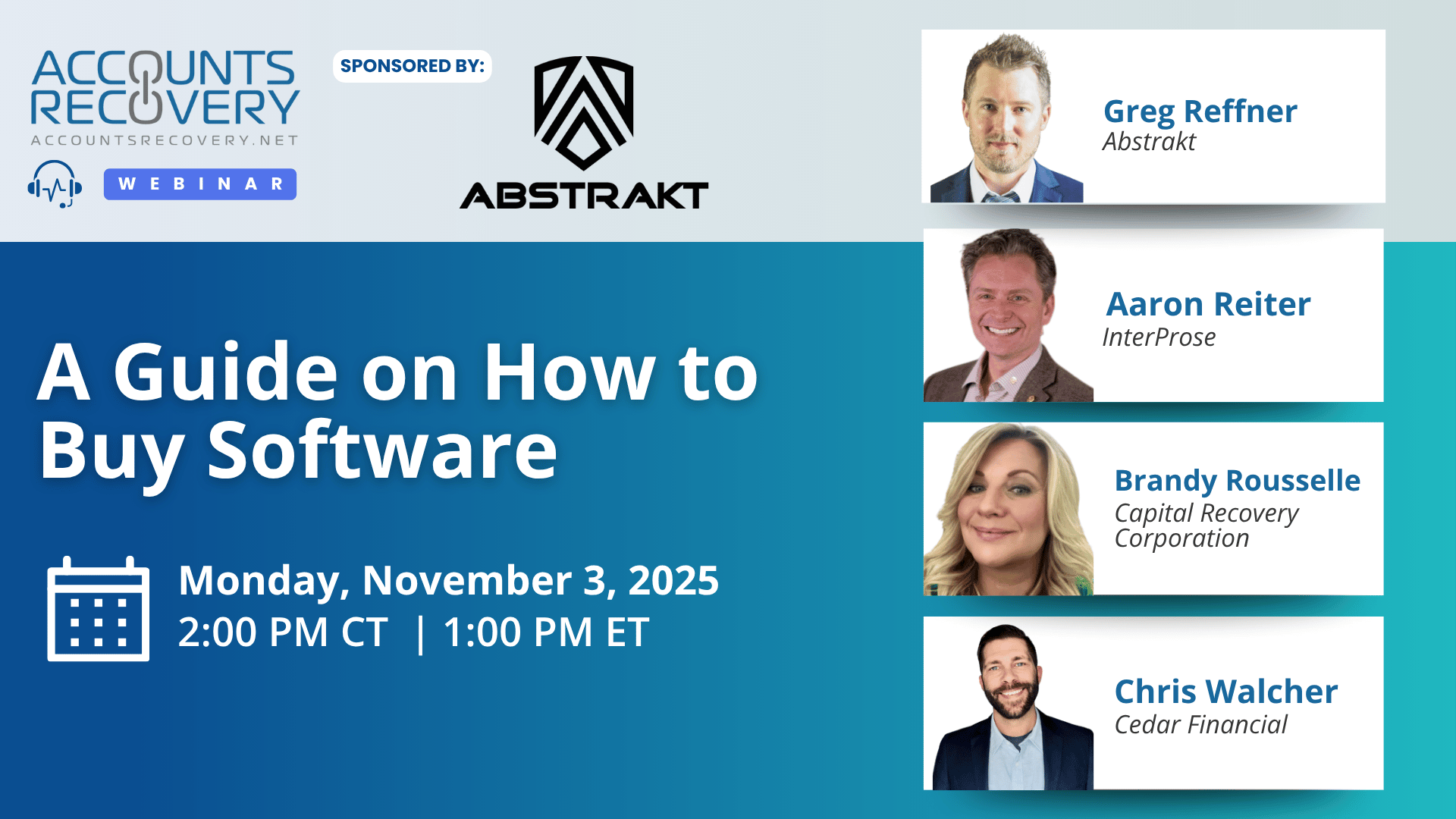
The webinar “A Guide on How to Buy Software”, sponsored by Abstrakt, brought together a panel of experts including Greg Reffner (Abstrakt), Aaron Reiter (Interpros), Brandy Rousselle (Capital Recovery Corp), and Chris Walcher (Cedar Financial). Moderated by Mike Gibb of AccountsRecovery.net, the session explored how collection agencies, creditors, and other financial organizations can make smarter, more strategic decisions when purchasing new technology.
The panel agreed that buying software isn’t just a technology decision—it’s an operational one. As Greg Reffner noted, “You need to figure out what made you realize something needs to change in the first place.” The discussion covered how to define your organization’s needs, assess current vendors, compare platforms, and evaluate post-purchase support. Brandy Rousselle emphasized that many companies chase “the shiny new toy” without first checking whether existing vendors can meet evolving needs. Chris Walcher reminded buyers to “clearly define the problem you’re trying to solve” before contacting vendors, or risk losing control of the process.
The panelists also underscored the importance of evaluating customer support. Reffner cited research showing that 70% of companies change software providers because of poor service—not product deficiencies. Strong support, they agreed, should be a primary decision factor.
🧠 Key Takeaways:
Start with Your “Why” – Define the catalyst for change and the specific problems you need to solve before scheduling demos.
Audit Existing Vendors – Check whether current partners can deliver new solutions or integrations before searching elsewhere.
Prioritize Support Over Features – Product features matter, but reliable, accessible support will determine long-term success.
The session offered a clear message: choosing the right software means aligning technology with operations, people, and long-term goals—not just buying tools, but building partnerships that last.
Webinar Recap: Breaking Down the CFPB's new FCRA Rule and What it Means for Credit Reporting

The CFPB’s new interpretive rule on the Fair Credit Reporting Act (FCRA) is reshaping how the industry views state-level credit reporting laws—particularly those governing medical debt. In this AccountsRecovery.net webinar sponsored by Connect International, legal experts Leslie Bender, Joann Needleman, and Manny Newburger explored what this development means for credit reporting, compliance, and the broader regulatory landscape.
The panel explained that the CFPB has reaffirmed that the FCRA broadly preempts state laws affecting credit reporting. This clarification restores national consistency, potentially invalidating recent state restrictions on reporting medical debt. However, as Needleman warned, the rule may invite legal challenges from consumer advocates questioning whether the Bureau has the authority to issue such interpretations under Loper Bright.
Newburger highlighted that this preemption aligns with Congress’s original intent: “When Congress specifically carved out California and Massachusetts, it meant everything else was preempted.” Bender added that while this ruling offers clarity, agencies and creditors must remain cautious—compliance and regulatory risk haven’t disappeared. State regulators continue to step up oversight, even as federal authority expands.
The discussion concluded with a strong message to the industry: don’t assume this rule means business as usual. Compliance diligence, documentation, and proactive engagement remain key to staying protected amid shifting legal terrain.
🧠 Key Takeaways:
Stay the course on compliance: Maintain adherence to both FCRA and applicable state laws until courts clarify preemption boundaries.
Expect more scrutiny: State-level examinations are increasing in intensity—be audit-ready and document every reporting process.
Leverage the rule strategically: Use the CFPB’s interpretive guidance to inform legislative advocacy and reinforce uniform federal standards.
This ruling may mark a step toward national consistency, but the road to true regulatory stability remains complex and contested.
Did you know you can get full access to all of my past webinars, along with transcripts and summaries of each, for only $29/month? Sign up to be a premium subscriber today!
The Daily Digest is sponsored by TCN
