- AccountsRecovery Daily Digest
- Posts
- Daily Digest - November 11, 2025
Daily Digest - November 11, 2025
Brought to you by: TCN | By Mike Gibb

Mike Gibb
November 11, 2025

🎂 Happy Birthday to Dusty Bunton of MedSrv, Jasmine Guo of Inter-Credit Group, and Kit Johnson of Resurgent Capital Services.
🎉Congratulations for starting new positions: David Jameson as Mid-Market Account Executive at Balto.
📝 Quick Notes
📖 Interested in joining a book club to discuss this book? Let me know.
Collector Facing FDCPA Class-Action Over Previously Disputed Debt
A collection operation is facing a class-action lawsuit for allegedly violating the Fair Debt Collection Practices Act by sending a Model Validation Notice to a consumer living in Kentucky who had previously disputed the debt’s existence when a collection attempt was made by a different collection operation.
This series is sponsored by WebRecon

A MESSAGE FROM TCN

TODAY‘S WEBINAR

UPCOMING WEBINARS
 |  |
 |  |
Judge Dismisses FDCPA Claims, Allows FCRA Claim to Proceed Against Creditor
A District Court judge in Illinois has granted motions to dismiss from two collection operations and the original creditor claims that they violated the Fair Debt Collection Practices Act, but denied the creditor’s motion to dismiss a claim it also violated the Fair Credit Reporting Act, questioning the creditor’s strategy to defeat the FCRA claim.
Collection Operation Discloses Data Breach Linked to Ransomware Attack
Wakefield & Associates, a Knoxville, Tenn.-based revenue cycle management and medical debt collection company, has begun notifying individuals of a data breach following a cyberattack that occurred earlier this year. The company confirmed that a threat actor gained access to its network on or before January 17, 2025, compromising sensitive consumer and client data.
Nearly 40% of Surprise Billing Disputes Found Ineligible: Survey
A growing number of surprise billing disputes are being submitted for arbitration despite not qualifying for the federal process, according to a new survey from AHIP and the Blue Cross Blue Shield Association (BCBSA). The findings point to systemic inefficiencies within the Independent Dispute Resolution (IDR) system established under the No Surprises Act (NSA), which was designed to protect patients from unexpected out-of-network medical bills.
WORTH NOTING: A new tool from Credit Karma will help consumers build credit with the bills they are already paying ... AI isn't quite there yet when it comes to automating most types of office work ... Bank of America is facing a class-action lawsuit for not paying employees over the time spent booting up their computers ... A 20-year banking veteran shares how he sees AI impacting this industry ... Is your weather app really giving you forecasts for your location? ... Road safety do's and don'ts that might end up saving your life ... Things to say instead of "how are you" when starting a conversation ... If you get more smiles and greetings at Target, here's why.
Trailer Tuesday, part I
Trailer Tuesday, Part II
Webinar Recap: How to Identify Consumers Who are Willing to Pay -- Reading the Signs
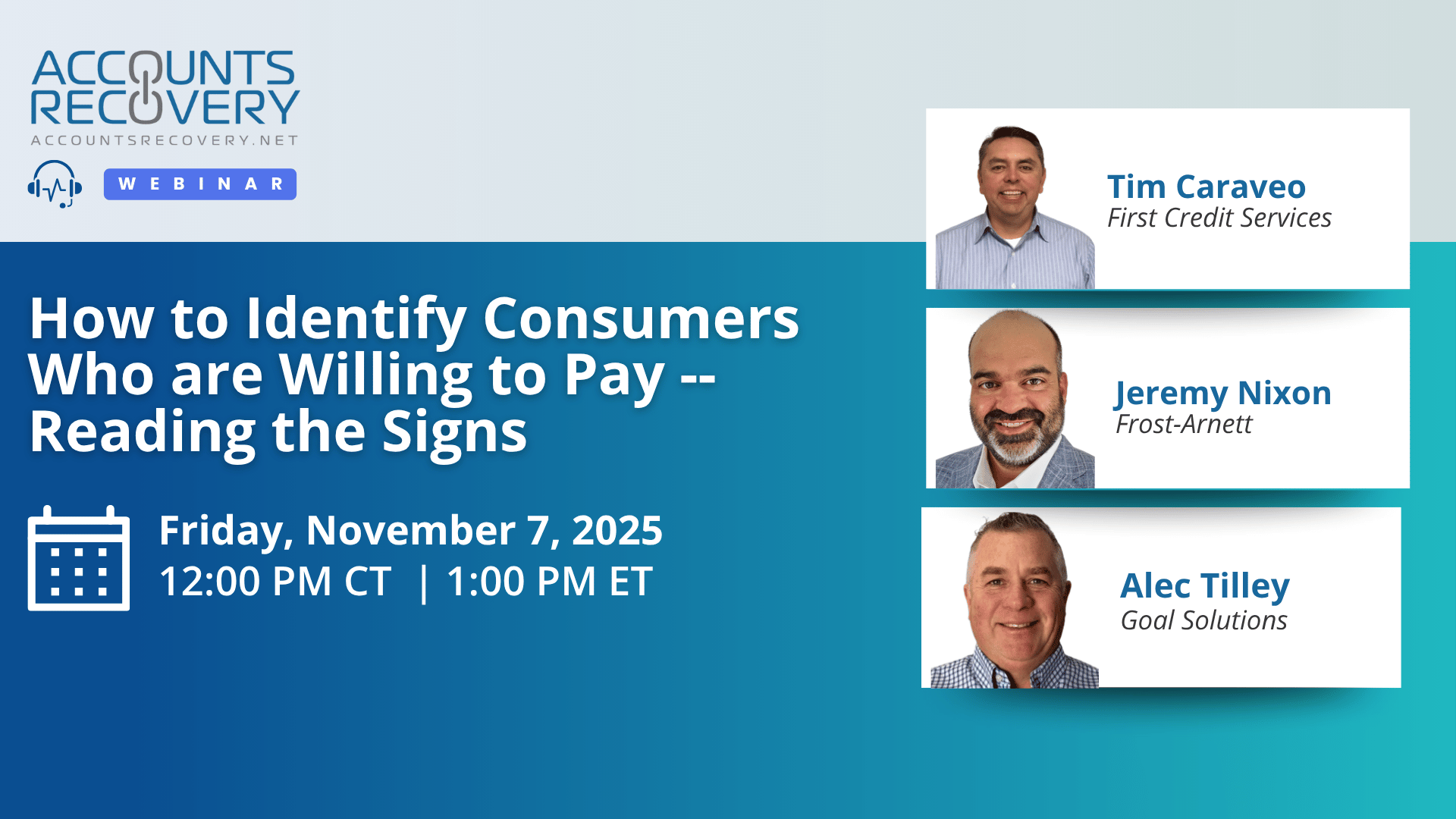
Not every consumer is the same when it comes to resolving debt—and understanding who is most likely to pay can make or break a collection strategy. In this webinar hosted by AccountsRecovery.net, industry leaders Tim Caraveo (First Credit Services), Jeremy Nixon (Frost-Arnett), and Alec Tilley (Goal Solutions) shared practical insights on how to spot “willing payers” early and tailor engagement strategies that drive better recovery outcomes.
The panelists agreed that engagement is the strongest indicator of intent to pay. Whether through calls, emails, or texts, a consumer’s willingness to respond or provide information signals potential for resolution. “It’s all about engagement—getting them to call to action and see who is willing to pay,” said Nixon. Caraveo emphasized aligning communication methods with consumer preferences, noting that many consumers today prefer self-service options over live calls.
Tilley highlighted the growing use of data-driven engagement scoring and machine learning models to predict response likelihood, helping agencies focus resources on accounts most likely to convert. However, panelists cautioned against over-contacting or relying solely on assumptions—too many touchpoints can lead to opt-outs or wasted resources.
Ultimately, the discussion reinforced that successful collection efforts hinge on using data intelligently, training collectors to recognize genuine intent, and adapting communication to each consumer’s behavior and preferred channel.
🧠 Key Takeaways:
Follow the signs of engagement: Track and respond to how consumers interact with texts, emails, and portals to prioritize those showing genuine interest.
Leverage data and scoring models: Use analytics to rank accounts by likelihood to pay and focus outreach where it’s most effective.
Balance persistence with efficiency: Avoid over-messaging and train collectors to distinguish between consumers who can’t pay and those who won’t pay.
By mastering these strategies, collection operations can boost liquidations while reducing wasted effort and compliance risks.
Webinar Recap: Using AI as the Ultimate Problem Solver

In a fast-evolving regulatory and operational landscape, AI is emerging as a transformative tool for credit and collection professionals. Sponsored by CSS Impact, this webinar featured Tim Collins (Pay Ready) and Juergen Lunkwitz (Contract Callers), who shared practical strategies for integrating AI into daily workflows—from email refinement and policy automation to voice-enabled collections and compliance controls.
Panelists emphasized that AI is no longer experimental—it’s operational. Agencies are using large language models (LLMs) to upscale communications, draft policies, and analyze account behavior in real time. Tim Collins noted, “This is the worst AI we’ll ever use in our lifetimes,” underscoring how quickly the technology is improving. Juergen highlighted the value of custom GPTs for tone control and consistency, especially when empowering field staff with digital assistants.
CSS Impact showcased its AI-powered collector platform, which allows agents to interact with accounts via voice, automate payment plans, and reduce wrap-up time—all while maintaining compliance and sentiment awareness.
Whether you're refining consumer messaging, optimizing staffing, or navigating regulatory complexity, AI offers scalable solutions that align with operational goals.
🧠 Key Takeaways:
Start with Prompt Engineering: Use frameworks like RTF (Role, Task, Format) or CRAFT to guide AI outputs and reduce hallucinations. Build internal GPTs for tone, urgency, and compliance.
Audit Shadow AI Usage: Identify where AI is already being used informally and establish governance policies to ensure safe, consistent deployment.
Leverage AI for Collector Efficiency: Explore voice-enabled tools and sentiment analysis to streamline account handling, improve consumer experience, and reduce operational costs.
Did you know you can get full access to all of my past webinars, along with transcripts and summaries of each, for only $29/month? Sign up to be a premium subscriber today!
The Daily Digest is sponsored by TCN
