- AccountsRecovery Daily Digest
- Posts
- Daily Digest - March 23, 2026
Daily Digest - March 23, 2026
Brought to you by: TCN | By Mike Gibb

Mike Gibb
March 23, 2026

🎂 Happy Birthday to the following: Jeff Mueller, MBA of FlexShopper, James Mastriani of Velocity Portfolio Group, and Lynne Labrador of Capital One. Happy belated Birthday to: Lee Douglas of Elevate Recoveries (March 22), Roxanne Bartley of TRAKAmerica (March 22), George Buck of USCB America (March 22), Jennifer Hewitt of Wells Fargo (March 22), Lance Wickham of BankruptcyWatch (March 22), Crystal Pinney of The Bank of Missouri (March 21), John Tammaro of New York Life Insurance Company (March 21), and Scott Purcell of ACA International (March 21).
🎉 Congratulations for starting new positions: Lisa Murphy as Vice President of Operational Excellence at Halsted Financial Services, Valerie Strawbridge as Senior Vendor Manager at TD, Eric Stover as Director of Operations at Island Recovery Solutions, Lee Morris as Chief Operations Officer at Capio, Christopher Mitcham as Head of Dealer Commercial Services for Santander Bank, N.A., and Michael Tornatore as Relationship Banker at Arvest Bank.
🏀 March Madness Update
Justin Miller is in first place after the first weekend of games in the NCAA March Madness pool, but he is being closely followed by Doug Traxler, David Grassi, Phil Ott, and Eric Nevels, with a number of others still in the mix. There is $850 in prizes up for grabs, thanks to Martin Golden Lyons Watts Morgan, TCN, Applied Innovation, Maxyfi, Debt$Net, and CSS Impact.
Logo Madness is Back!
The quest to identify the best logo in the credit and collections industry is here. Click here to submit your logo and click here to see the past winners.
NEW: Digital Communications Survey
✅ Click here and take a quick digital communications and benchmarking survey
Illinois Appeals Court Rejects FDCPA Claims Over ‘Blank’ Summons in Collection Case
An Illinois Appeals Court has upheld a ruling in favor of a bank and a collection law firm that were accused in class-action counterclaims of violating the Fair Debt Collection Practices Act by serving the plaintiff with a blank summons in an underlying collection lawsuit.

A MESSAGE FROM TCN

TODAY’S WEBINAR

UPCOMING WEBINARS
 |  |
 |  |
New Data Shows Growing Bad Debt Burden for Hospitals
Hospitals across the U.S. are facing mounting financial pressure to start 2026, with new data showing rising bad debt, increasing expenses, and declining patient volumes. For professionals in the credit and collection industry, the trend is clear: more accounts are likely to flow into collections, and healthcare providers may be under greater pressure to recover revenue. The question now is not whether bad debt is growing, but how quickly and how much it will impact recovery strategies in the months ahead.
How ChatGPT Is Quietly Reshaping Consumer Complaints and Outcomes
This report is from last year and I don’t think I’ve written about it yet, and The Wall Street Journal last week ran an article from one of the report’s authors that resurfaced it, so I wanted to either write about it again or write about for the first time because it’s interesting that artificial intelligence may help consumers get better results when complaining, especially with regulators like the Consumer Financial Protection Bureau.
Judge Dismisses ID Theft FCRA Claims Over Insufficient Pleading
A District Court judge in New York has granted motions to dismiss a Fair Credit Reporting Act lawsuit filed by a plaintiff who claimed to be the victim of identity theft and who disputed information that appeared on his credit report.
Compliance Digest – March 23
Important insights from Mike Frost, Virginia Bell Flynn, Jeff Turner, and Akeela White are in this week's Compliance Digest. They break down a number of recent rulings and make sure you know exactly what you need to know to see if you need to make any changes to how you are engaging with consumers.
This series is sponsored by Frost Echols
WORTH NOTING: These days, it's probably not a surprise that you are reading more AI-generated news than you think ... Tracking your sleep may be preventing you from getting a good night's rest ... The ideal fast food meal comes from a number of different restaurants ... Scammers are going as far as to contact tech support pretending to be you to get you to change your passwords ... Rising electricity bills are likely to take over the midterm election agenda ... How to get more out of Google's Gemini ... Should you let your phone charge overnight? ... There is a growing shortage of volunteer firefighters, which is causing problems across the country.
Music Monday, part I
Music Monday, Part II
Webinar Recap: Training a Remote Workforce
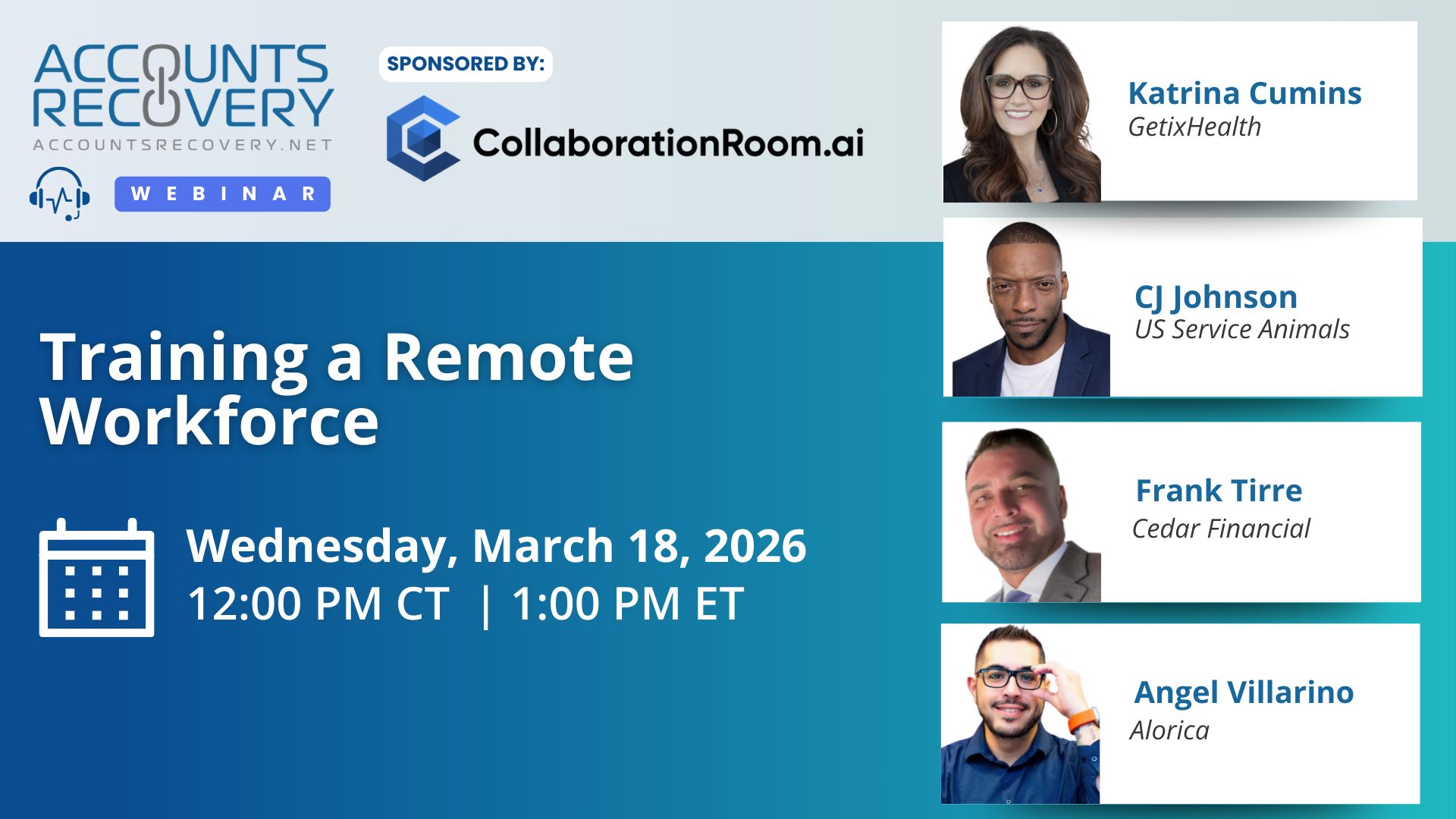
Hosted by Mike Gibb and sponsored by CollaborationRoom.AI, this session explored how collection operations can effectively train, coach, and motivate employees in remote and hybrid environments. Panelists from Cedar Financial, GetixHealth, Alorica, and US Service Animals shared practical strategies for replicating informal learning, refining training programs, and leveraging technology to ensure compliance and performance.
Key themes included:
Recreating informal learning remotely: Frank Tirre emphasized using Microsoft Teams and virtual shadowing to mimic in‑office collaboration. Angel Villarino added that “every session requires interaction,” recommending polls, chat, and breakout exercises to drive engagement.
Continuous refinement of training: CJ Johnson noted, “You have to have a clearly defined journey for what your people are going to experience when they are onboarded.” His team treats training as an evolving product, aligned closely with floor operations.
Feedback loops: Katrina Cumins highlighted the importance of surveys at 2 weeks, 30 days, and 90 days to identify weaknesses. Her team extended training from one to two weeks after feedback revealed gaps in system navigation and call preparation.
Technology solutions: Jason Hiland demonstrated Collaboration Room’s patented SaaS platform, which mirrors the contact center floor virtually, offering compliance alerts, engagement metrics, and multi‑monitor streaming—capabilities missing from general tools like Zoom or Teams.
🧠 Key Takeaways:
Build structured feedback cycles: Implement surveys and questionnaires at multiple intervals to refine training content and identify gaps early.
Prioritize engagement in remote sessions: Use interactive tools—polls, breakout rooms, shadowing—to replicate the informal learning that happens naturally in offices.
Leverage purpose‑built technology: Adopt platforms designed for contact centers to monitor compliance, track engagement, and support agents effectively in remote and hybrid environments.
This webinar underscored that effective remote training is not about replicating classroom methods—it requires intentional design, continuous feedback, and the right technology to ensure compliance and performance in today’s credit and collections landscape.
Webinar Recap: Defending Against AI-Assisted Pro Se Plaintiffs
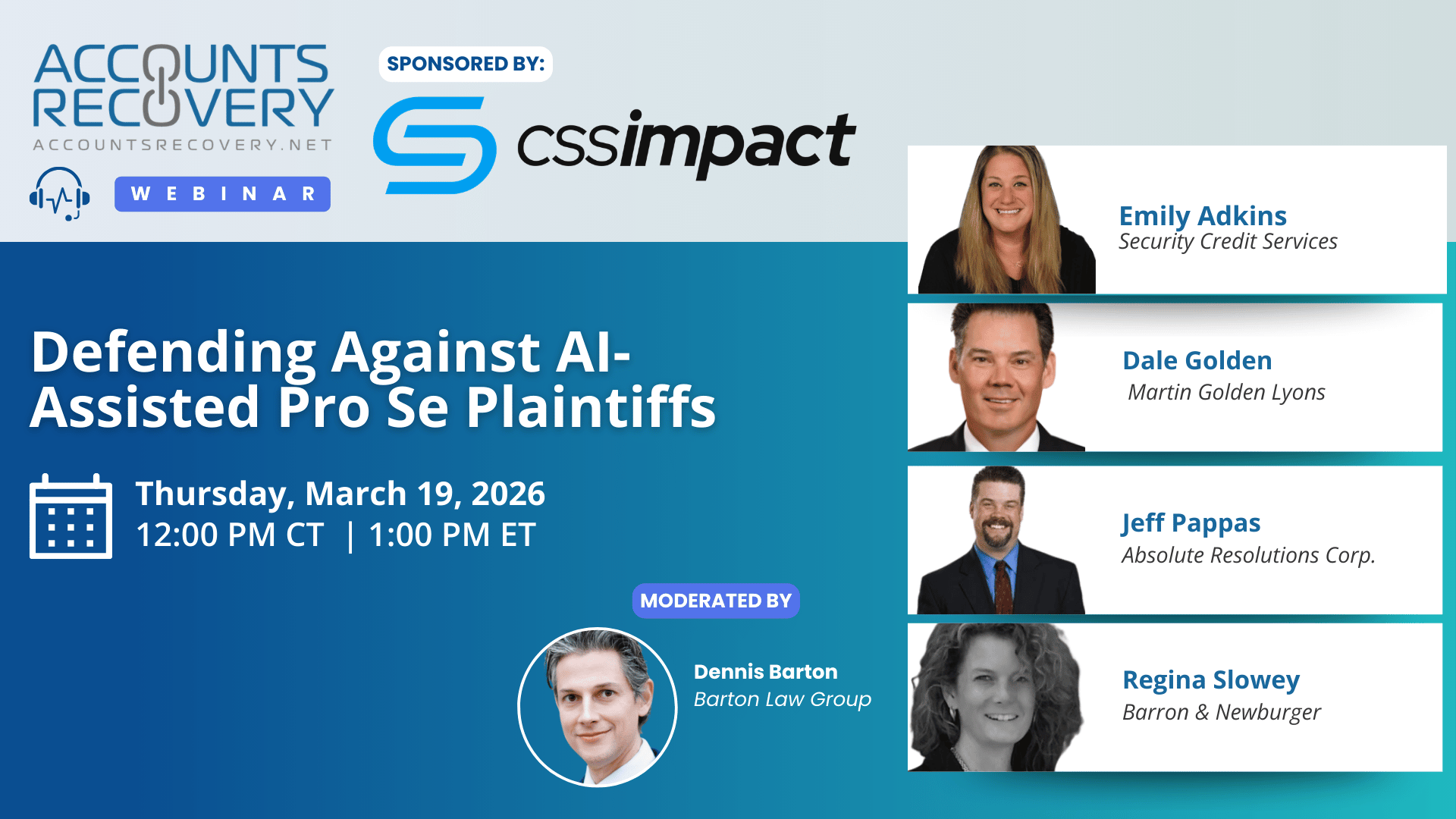
The recent webinar, sponsored by CSS Impact, highlighted how AI tools like ChatGPT are reshaping litigation strategies for pro se plaintiffs in the credit and collections industry. Panelists noted that filings are increasingly polished, referencing statutes and resembling work from junior attorneys. While many claims remain frivolous, the sheer volume and confidence AI provides to self-represented litigants are creating new challenges for agencies, debt buyers, and financial institutions.
Key discussion points included:
Signals of change: AI-generated pleadings are more structured, consistent, and embolden plaintiffs to act like seasoned attorneys. As Emily Atkins observed, “It’s like they have their Batman suit on.”
Types of claims: Common filings involve FDCPA and FCRA violations, chain of title disputes, and demands for validation notices. Some litigants even use AI in real-time during hearings to generate cross-examination questions.
Strategic adjustments: Panelists warned against blanket settlements or “mutual walks,” which can fuel copycat claims via social media. Instead, firms should balance early resolution with firm boundaries to avoid incentivizing frivolous litigation.
🧠 Key Takeaways:
Strengthen Documentation Practices
Ensure chain of title, validation notices, and signed agreements are readily available to counter AI-generated challenges that often allege insufficient proof.Avoid Feeding the Trend
Settling frivolous claims too easily can encourage copycat lawsuits. As Regina Slowey put it, “Don’t feed the bears.” Establish clear boundaries to discourage repeat filings.Collaborate Across the Industry
Develop shared strategies to address viral trends (e.g., TikTok-driven templates) and prevent widespread misuse of AI in litigation.
Bottom line: AI is giving pro se plaintiffs a “Superman cape,” but with strong documentation, disciplined settlement strategies, and industry collaboration, credit and collections professionals can stay ahead of this evolving challenge.
Webinar Recap: NYC Debt Collection Rule Q&A

The recent webinar unpacked the New York City Debt Collection Rule, offering clarity on its scope, compliance requirements, and operational impact across the credit and collections ecosystem. Panelist emphasized that the rule is not just about avoiding penalties but about reshaping consumer engagement.
Key provisions discussed included new disclosure requirements, stricter limits on communication frequency, and enhanced recordkeeping obligations. The panelist remarked, “Transparency is not optional—it’s mandatory,” underscoring the rule’s consumer-first intent. “The rule is clear in intent, but the gray areas are where compliance risk lives,” highlighting the importance of proactive interpretation.
The conversation also explored industry-wide implications. Debt buyers raised concerns about portfolio valuation, while banks and credit unions stressed vendor oversight alignment. Fintechs viewed the rule as an opportunity to differentiate through consumer-friendly practices. Best practices shared included adopting compliance dashboards, standardizing communication templates, and fostering collaboration across compliance, operations, and legal teams.
Ultimately, the session reinforced that compliance must be embedded into daily operations. As the panelist concluded, “Compliance is not just about avoiding penalties—it’s about building trust with consumers.”
🧠 Key Takeaways:
Audit and Update Procedures: Review current practices against NYC’s debt collection rule, ensuring disclosures and communication templates meet new standards.
Invest in Training and Technology: Equip staff with updated guidance and leverage compliance dashboards or monitoring tools to reduce risk.
Embed Consumer-Centric Practices: Treat compliance as an opportunity to build trust and credibility, not just as a regulatory obligation.
This summary positions the NYC Debt Collection Rule as both a compliance challenge and a strategic opportunity for agencies, debt buyers, fintechs, and financial institutions to strengthen consumer trust while staying ahead of enforcement trends.
Webinar Recap: The Art of Texting – Strategies for Text Messaging in Collections

The webinar, sponsored by Concepts2Code, highlighted how text messaging has become a vital tool for debt collection agencies, lenders, and healthcare providers seeking to engage consumers effectively while remaining compliant. Panelists emphasized that texting is no longer optional—it’s a preferred communication channel that meets consumers where they are. As one speaker put it: “Texting isn’t just about speed—it’s about respect and convenience.”
The discussion covered compliance frameworks, consumer engagement strategies, and technology integration. Experts stressed that adherence to TCPA and CFPB guidelines is essential, not only to avoid risk but also to build trust. Consent management and opt-out mechanisms were described as the foundation of any texting program.
Panelists also shared practical strategies for improving engagement, such as keeping messages short, using empathetic language, and including clear calls to action. Personalization was highlighted as a differentiator—messages that feel human and relevant drive higher response rates. Technology platforms that integrate texting with CRM systems and payment portals were presented as key enablers, allowing agencies to scale outreach while maintaining compliance.
The session closed with a reminder that texting should be part of a broader omnichannel strategy. When combined with email, phone, and digital portals, SMS creates a seamless consumer experience that improves right-party contact rates and payment outcomes.
🧠 Key Takeaways:
Prioritize compliance and consent: Ensure texting programs align with TCPA and CFPB rules, with clear opt-in and opt-out processes.
Personalize and humanize messaging: Use empathetic, concise language and tailor outreach to consumer preferences for better engagement.
Integrate texting into omnichannel strategies: Combine SMS with email, phone, and portals to maximize reach and improve payment conversions.
This summary positions texting as both a compliance-sensitive and consumer-friendly tool, offering actionable insights for professionals across collections, finance, and healthcare.
Did you know you can get full access to all of my past webinars, along with transcripts and summaries of each, for only $29/month? Sign up to be a premium subscriber today!
The Daily Digest is sponsored by TCN