- AccountsRecovery Daily Digest
- Posts
- Daily Digest - March 17, 2026
Daily Digest - March 17, 2026
Brought to you by: TCN | By Mike Gibb

Mike Gibb
March 17, 2026

🎂 Happy Birthday to the following: Jenna Farkas of AmeriCU Credit Union, Elizabeth Schuerman of MBSi Corp., Phylisha Allen of VWi Vengroff Williams, Ayesha Gupta of Hilbert Investment Solutions.
🎉 Congratulations for starting new positions: Doug Marohn as Chief Executive officer at 1803 Capital, LLC / Edge Financial Services, Joseph Conlon as Senior Director, Specialty Servicing / Operations Exam & Control Support at SoFi, Jeffi Mathew as Account Executive at Airwallex, David Wilson as SVP, Platform & System Transformation at PCA Global Ventures, Omar Aguilar as Account Manager at Dekota Financial, Michele Fairbanks as Assistant Manager at CNG Holdings, Sarah Heimburg as Mortgage Loan Originator at Haus Capital Corporation, and Sonia Chiriboga as Head of Dispute Management at Spring Oaks Capital.
🏀 $850 in Prizes for Winners of March Madness!
Click here to enter the AccountsRecovery free March Madness pool. There is $850 in prizes up for grabs, thanks to Martin Golden Lyons Watts Morgan, TCN, Applied Innovation, Maxyfi, Debt$Net, and CSS Impact.
Logo Madness is Back!
The quest to identify the best logo in the credit and collections industry is here. Click here to submit your logo and click here to see the past winners.
NEW: Digital Communications Survey
✅ Click here and take a quick digital communications and benchmarking survey
Agency Sued for Allegedly Calling Consumer After Debt Was Paid
A debt collection operation that focuses on collecting apartment-related debts is facing a lawsuit in federal court in Arizona for allegedly continuing to call a consumer even after the individual informed the company that the debt had already been paid.
This series is sponsored by WebRecon

A MESSAGE FROM TCN

TODAY’S WEBINAR
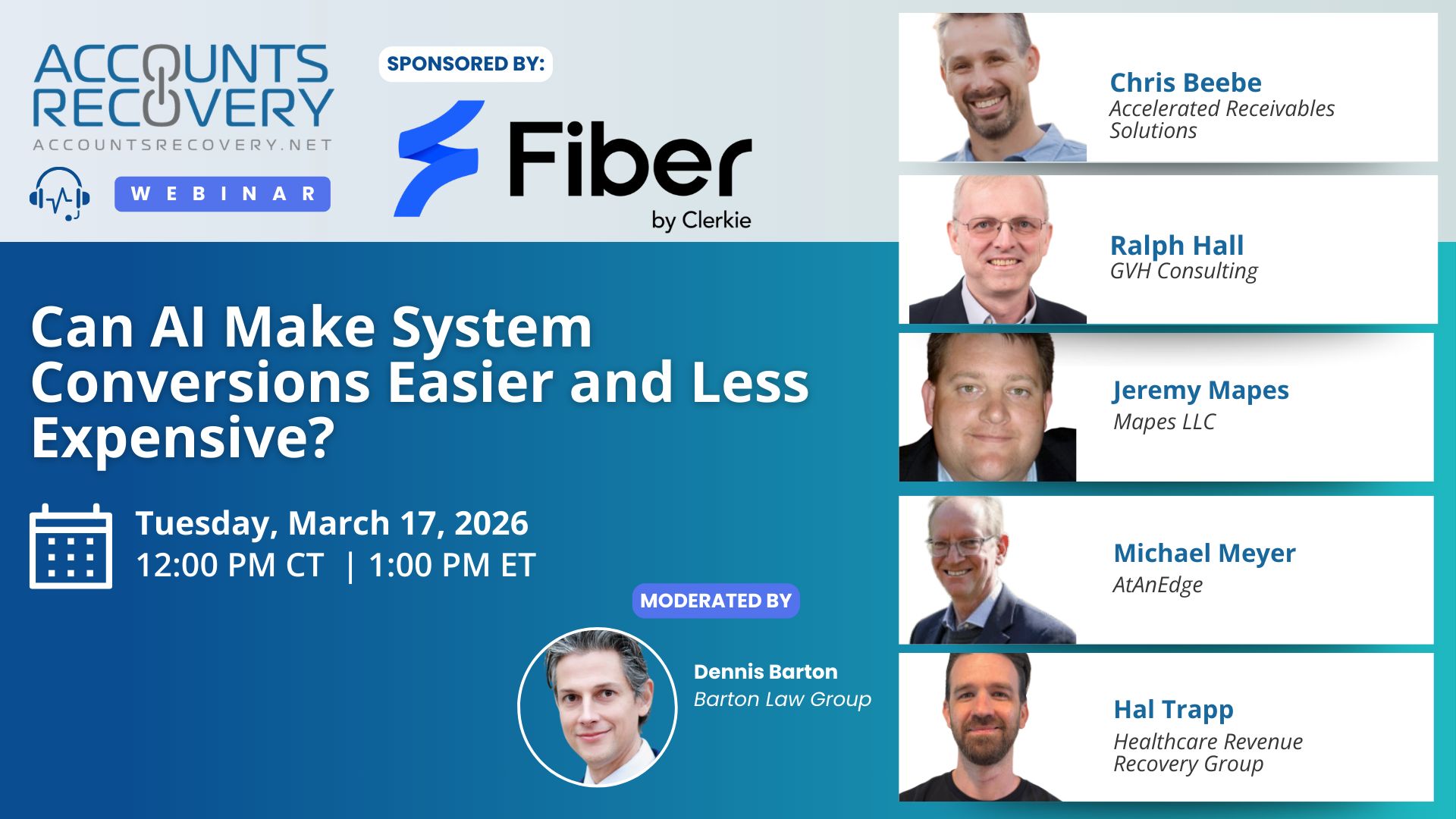
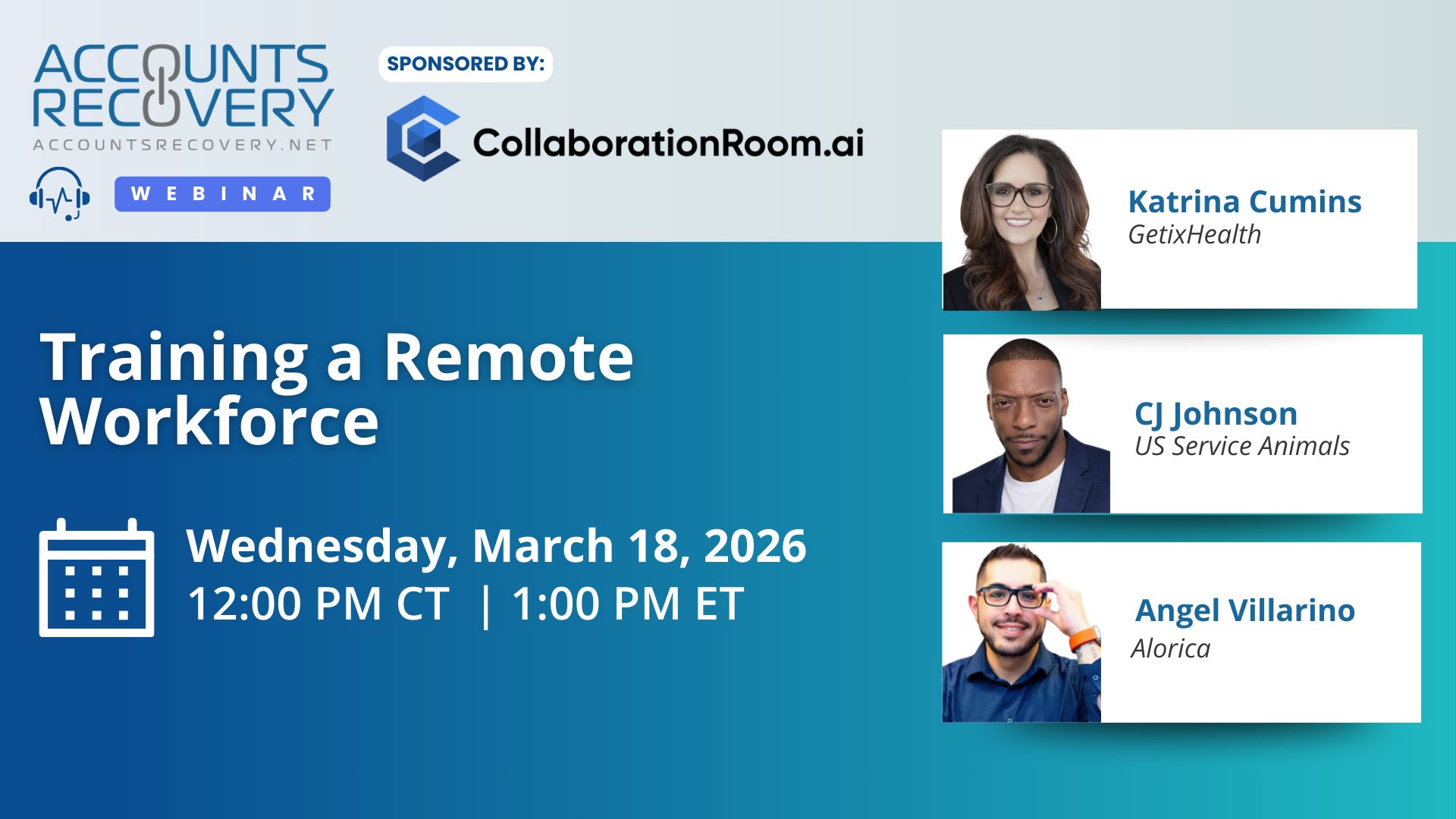
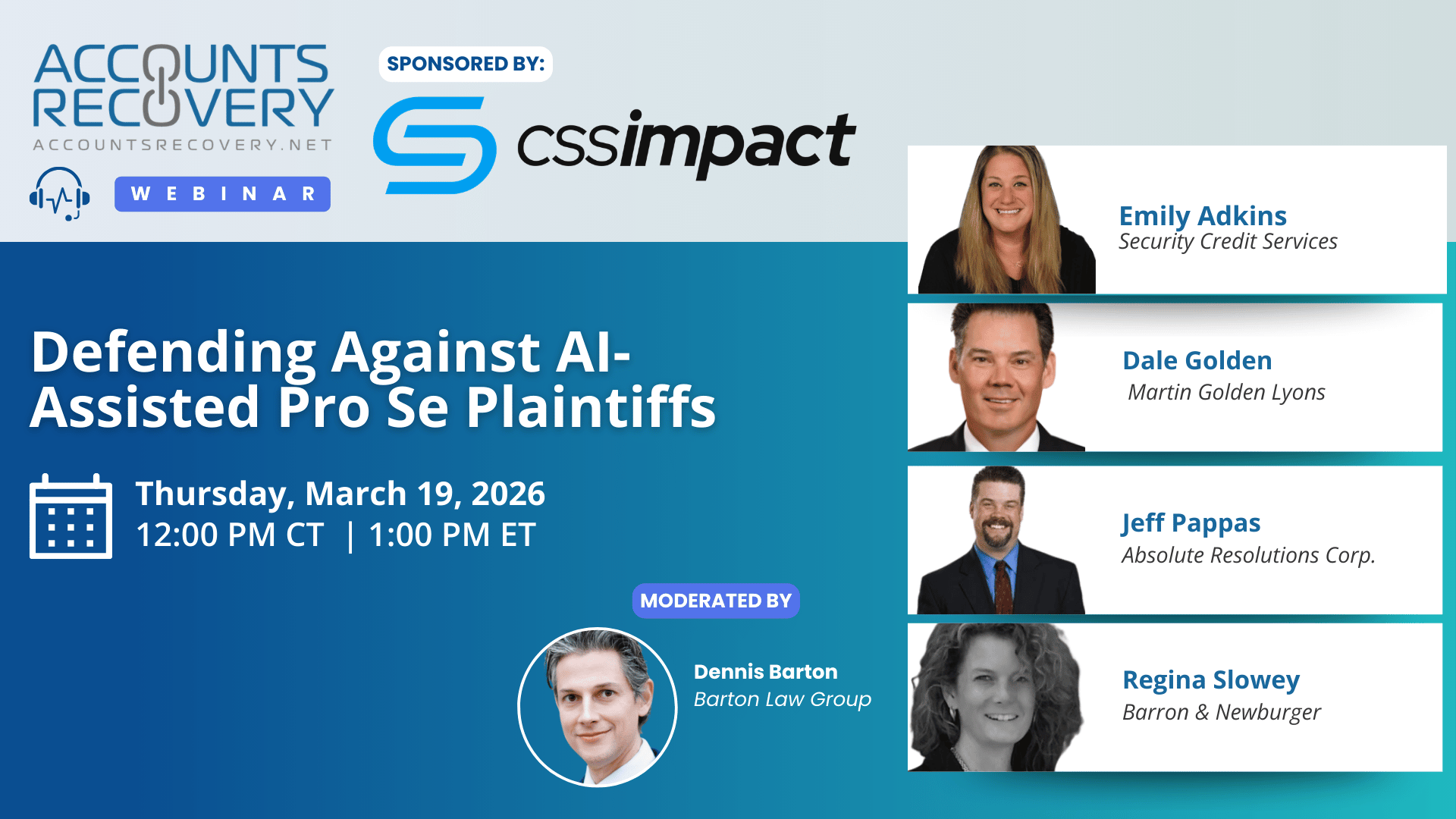
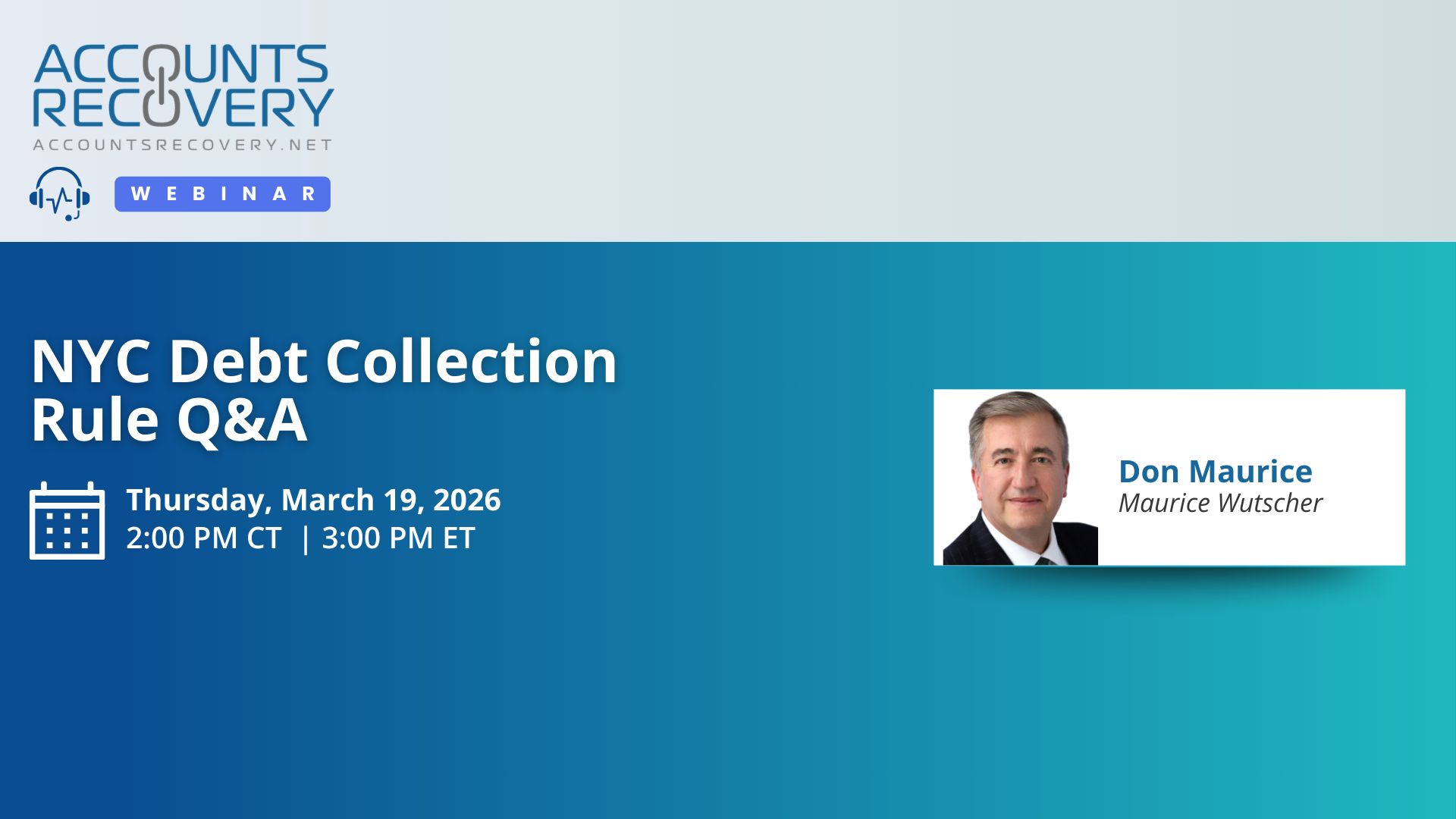
UPCOMING WEBINARS
 |  |
 |  |
 |  |
Wisc. Supreme Court Reverses Class Certification in FDCPA Suit
The Wisconsin Supreme Court has reversed a state appeals court certification of a class in a Fair Debt Collection Practices Act suit, ruling that a defendant may prevent a damages class action under the Wisconsin Consumer Act by offering an appropriate remedy to the individual plaintiff who brought the case, rather than to the entire proposed class. The court concluded that the lower courts relied on an incorrect interpretation of the statute governing consumer class actions.
Consumers Feel a Bit Better About Missing Payments, Even as Confidence in the Job Market Slips
The Federal Reserve Bank of New York’s latest Survey of Consumer Expectations suggests consumers entered March with a somewhat better outlook on their near-term ability to stay current on debt, even as they grew a little less confident about the labor market. For companies in the credit and collection industry, that combination matters. It points to a consumer who may be feeling less immediate payment stress, but who is still cautious about job mobility, wage growth, and the broader economic backdrop.
FCRA Suit Over Fraud Alert Ends in Dismissal After Plaintiff Floods Court With Filings
What started as a Fair Credit Reporting Act case against a bank for allegedly placing an erroneous fraud-alert restriction on the plaintiff’s account turned into a lot more, leading a District Court judge in Missouri to dismiss the suit. The court ultimately ruled that the plaintiff repeatedly violated court orders throughout the litigation, filing dozens of motions and communicating with court staff in ways that directly violated restrictions imposed by the judge.
13 State AGs Sue OneMain Financial Over Alleged Hidden Loan Add-Ons
A coalition of 13 state attorneys general yesterday announced they had filed a lawsuit against non-bank installment lender OneMain Financial, accusing the company of misleading borrowers and inflating loan costs by adding insurance policies and other products to loans without consumers’ knowledge. The case, filed in federal court in New York, alleges the company’s practices saddled tens of thousands of borrowers with hundreds of millions of dollars in additional costs.
WORTH NOTING: The dictionary is suing the company behind ChatGPT ... The 12 most misused buzzwords and phrases in IT ... A survey and analysis of the credit card landscape ... The ways that consumers are trying to cope with higher inflation aren't working ... A look at how first-time homebuyers are making their purchases ... The parent company of Facebook is eyeing a massive layoff ... A method to help you fall asleep faster ... Google Maps has unveiled a bunch of new features ... Modern etiquette mistakes and how to avoid them.
Trailer Tuesday, part I
Trailer Tuesday, Part II
Webinar Recap: Beyond the Demo: How to Actually Evaluate and Deploy Virtual Agents in Collections

The session, sponsored by Veritus, highlighted the gap between polished vendor demos and the realities of deploying virtual agents in debt collection and financial services. Panelists from fintechs, banks, and technology providers stressed that demos often showcase idealized scenarios, while actual implementation requires careful planning, compliance alignment, and integration with existing systems. As one speaker put it, “A demo is theater; deployment is reality.”
Discussions centered on how organizations can evaluate solutions beyond surface features, test them with real customer data, and ensure they meet regulatory standards. Panelists shared lessons learned from pilot programs, emphasizing the importance of cross‑functional collaboration and iterative improvement. The conversation underscored that virtual agents are not just cost‑saving tools but must enhance customer experience and trust.
🧠 Key Takeaways:
Evaluate beyond the demo: Request proof‑of‑concept trials using real accounts and data to see how virtual agents perform under actual conditions.
Prioritize compliance and customer trust: Ensure solutions are designed to handle sensitive financial and healthcare information securely while improving—not frustrating—the customer journey.
Start small, scale smart: Pilot in one segment, measure ROI through KPIs such as call deflection and payment recovery, then expand thoughtfully across portfolios.
The webinar reinforced that successful deployment of virtual agents requires balancing technology with regulatory compliance and customer‑centric design. Organizations should treat implementation as an evolving process, continuously refining scripts, workflows, and integrations. As one panelist concluded, “If you can’t measure it, you can’t manage it.”
By moving beyond the demo and focusing on practical evaluation, debt collection agencies, financial institutions, and healthcare providers can unlock the true potential of virtual agents to drive efficiency and improve customer outcomes.
Webinar Recap: Communication Orchestration vs. Omnichannel: The Gap Between Capability and Outcome
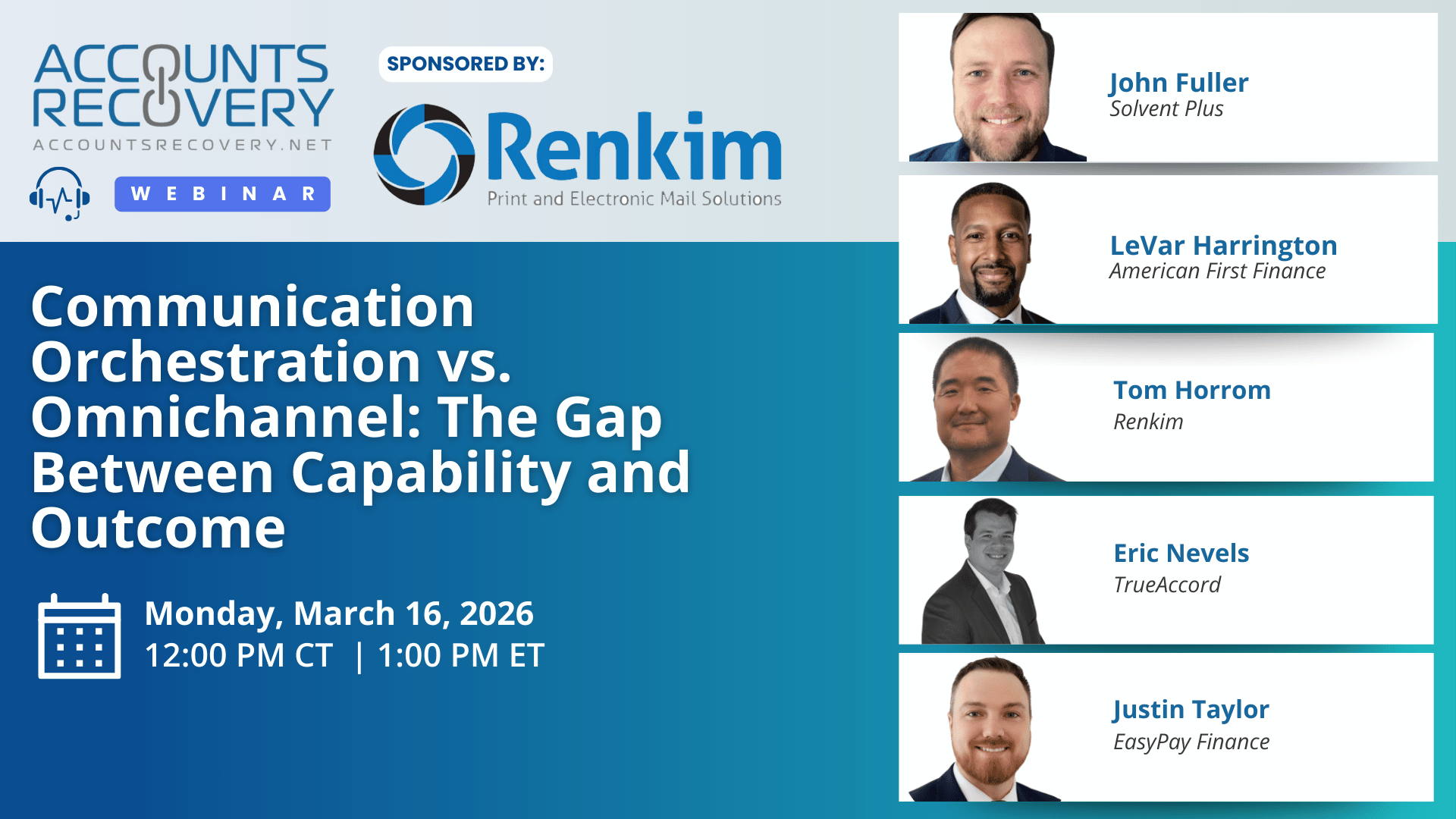
In a recent webinar, sponsored by Renkim, industry leaders explored the difference between simply offering multiple communication channels (multichannel) and achieving true omnichannel orchestration—where channels are integrated, coordinated, and informed by consumer data.
Panelists emphasized that while many organizations have invested in tools like email, SMS, chat, IVR, and virtual agents, few are realizing the promised outcomes of higher right-party contact rates, stronger compliance, and improved consumer experience.
Eric Nevels (TrueAccord) captured the essence: “Omnichannel really means that the channels know about each other and behave as one system.” True orchestration requires unified consumer data, real-time decisioning, and compliance safeguards.
Tom Horrom (Renkim) stressed that orchestration begins with data: understanding consumer behaviors and leveraging insights to guide communication choices. John Fuller (Solvent Plus) highlighted the importance of real-time attribution, noting that “just-in-time” decisions are essential to avoid compliance risks and maximize engagement.
Panelists also discussed challenges such as overlapping channel use (e.g., consumers engaging via both email and SMS) and warned against “spamming” without a clear communication flow. Instead, organizations should design strategies that respect consumer preferences and prioritize channels based on intent.
Finally, the group urged agencies to move beyond siloed metrics like open rates or RPCs. Instead, they should measure resolution rates, time to resolution, and cost per resolution to truly understand the effectiveness of their communication strategies.
🧠 Key Takeaways:
Audit your communication strategy: Ensure you are orchestrating channels, not just offering them.
Invest in unified data and real-time decisioning: This enables AI-driven orchestration while maintaining compliance.
Measure what matters: Focus on resolution outcomes and cost efficiency, not just channel-specific engagement metrics.
This webinar underscored that the future of consumer communication lies not in adding more channels, but in orchestrating them intelligently to deliver better outcomes.
Did you know you can get full access to all of my past webinars, along with transcripts and summaries of each, for only $29/month? Sign up to be a premium subscriber today!
The Daily Digest is sponsored by TCN