- AccountsRecovery Daily Digest
- Posts
- Daily Digest - February 26, 2026
Daily Digest - February 26, 2026
Brought to you by: TCN | By Mike Gibb

Mike Gibb
February 26, 2026

🎂Happy Birthday to the following: Calder Willingham of Creditors Bureau Associates, and Janice McGoldrick of Action RCM Powered by Harris & Harris.
Getting to Know Megan Howard of Reliant Capital Solutions
Megan Howard is someone who loves to solve problems. And not just the problem in front of her. But the one that’s likely to come next. She’s found a home as the Chief Administrative Officer at Reliant Capital Solutions, where she has spent her entire career in collections. Read on to learn more about Megan, why doing things the right way and not the easy way is so important to her, and what makes her so good at solving problems.
This series is sponsored by TEC Services Group

A MESSAGE FROM TCN

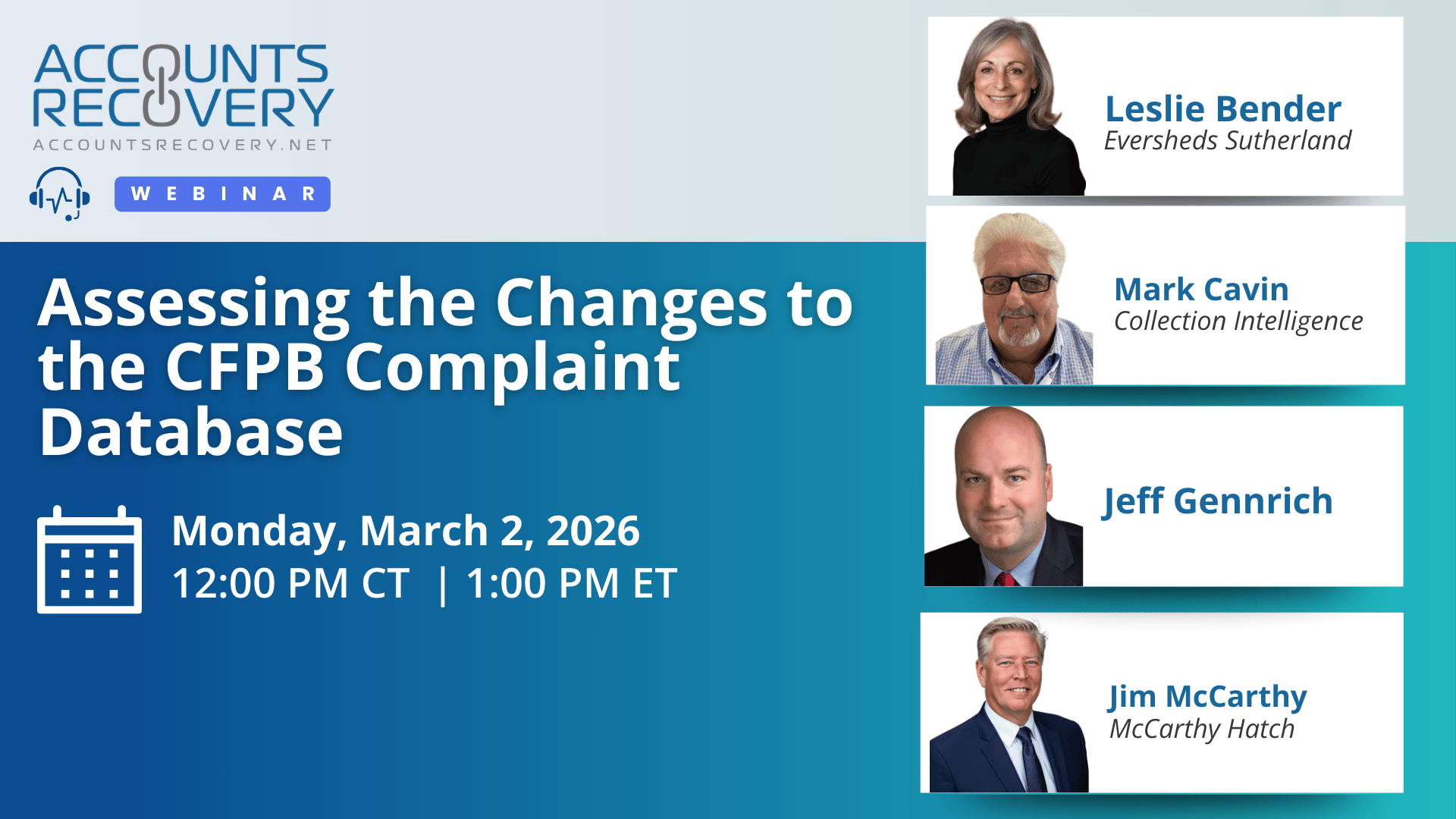
TODAY’S WEBINAR

UPCOMING WEBINARS
 |  |
 |  |
 |
NYC Finalizes New Debt Collection Rule
New York City today has formally adopted a sweeping set of amendments to its debt collection rules, locking in expanded compliance obligations for collection agencies, debt buyers, and original creditors once they engage in “debt collection procedures,” with an effective date of September 1, 2026. The final rule clarifies long-debated issues around communication limits, validation and verification, time-barred debt disclosures, medical debt verification, and recordkeeping, and confirms that original creditors are not exempt once accounts enter collection. For companies in the credit and collection industry, the changes reinforce that New York City remains one of the most prescriptive local regimes for consumer debt collection.
Judge Dismisses TCPA Case, Finds Texts Are Not ‘Telephone Calls’
A District Court judge in Georgia has granted a defendant’s motion to dismiss a Telephone Consumer Protection Act case, ruling that text messages do not meet the statute’s definition of “telephone calls.” The decision is a break from other federal courts that have ruled in the past that text messages are calls under the TCPA.
Judge Dismisses FCRA Claim Based on Sovereign Citizen Payment Theory
A District Court judge in New York has agreed with a Magistrate Court judge and dismissed a Fair Credit Reporting Act case filed against a creditor by a sovereign citizen who claimed the defendant reported his account as delinquent even though he used a “security interest” to make a payment.
Encore Capital Posts Record 2025 Collections
Encore Capital Group used its fourth-quarter 2025 earnings call to do two things the credit and collections industry does not often get to see in public: lay out the “why” behind a monster year of performance and put a stake in the ground for what comes next. The company reported full-year 2025 net income of $257 million and said it expects 2026 earnings to rise 10%, with global portfolio purchases of $1.4 to $1.5 billion and global collections up 5% to $2.7 billion. Management also pushed back on the growing narrative of consumer distress, saying it has seen “no impact” on payer conversion, payment plans, or plan resilience so far.
WORTH NOTING: A look at how college students are managing their personal finances ... How states are using artificial intelligence for compliance enforcement ... People share the dumbest things they've seen others do with money ... Of all the things that passengers can do to annoy drivers, this is at the top of the list ... The CEO of NVIDIA says the artificial intelligence boom is just getting started ... Tips to help you get faster replies when sending emails ... Ways to make decisions when you don't have all the information ... How a couple turned an abandoned fire station into their dream home.
Top 10 Thursday, part I
Top 10 Thursday, Part II
Webinar Recap: What Data Do You Need to Train Your AI Models

In a recent webinar hosted by Mike Gibb and sponsored by CSS Impact, industry leaders explored the critical role of data in training AI models for debt collection. The discussion emphasized that effective AI is not about amassing vast datasets but about identifying the right features to answer specific business questions.
Michael Meyer noted, “You don’t need 50 years of history; you need near-term actions and intentions.” Lauren Valenzuela warned against the “hoarder fallacy,” stressing that AI requires structured features, not raw data, and highlighted the importance of privacy by design. Austin Cauthon added that organizations should “start with the question” rather than the data, ensuring AI efforts align with revenue-driving goals.
Panelists also distinguished between machine learning (used for predictive scoring and stratification) and large language models (LLMs), which excel at language-based tasks but can hallucinate or generate inaccurate outputs. Compliance and security risks were discussed, with Valenzuela pointing to recent legal cases underscoring the dangers of inputting sensitive information into open-source LLMs.
The group agreed that while AI offers transformative potential, human oversight, clear objectives, and strong data hygiene practices are essential to avoid costly missteps.
🧠 Key Takeaways:
Start with the question, not the data: Define the business problem first, then identify the specific data features needed to answer it.
Quality over quantity: Avoid the “hoarder fallacy.” Structured, relevant data is more valuable than massive historical datasets.
Balance innovation with compliance: Use privacy by design, maintain clean datasets, and ensure human oversight to validate AI outputs.
Did you know you can get full access to all of my past webinars, along with transcripts and summaries of each, for only $29/month? Sign up to be a premium subscriber today!
The Daily Digest is sponsored by TCN