- AccountsRecovery Daily Digest
- Posts
- Daily Digest - February 25, 2026
Daily Digest - February 25, 2026
Brought to you by: TCN | By Mike Gibb

Mike Gibb
February 25, 2026

🎂Happy Birthday to the following: Kyle Collins of Spring Oaks Capital, Jordan Romano of Orbita Capital Group, and Joel Rickman of Equifax.
🎉Congratulations for starting new positions: Anthony Jones as Head of Revenue, Kojo Credit at Kaizen Pay.
Coming April 20-22 … TCN’s C3 User Conference

Conn. Regulator Fines Collection Agency $100k for Calling Hospital Emergency Line
The Connecticut Department of Banking has fined a collection operation $100,000 for calling a hospital’s emergency phone line in an attempt to collect on a debt. The enforcement action stems from repeated calls placed to a hospital after staff told the collector that the number was an emergency medical line and asked that the calls stop. The state also found licensing and third-party contact issues tied to the activity, resulting in an order to cease and desist and the maximum civil penalty allowed under state law.

A MESSAGE FROM TCN

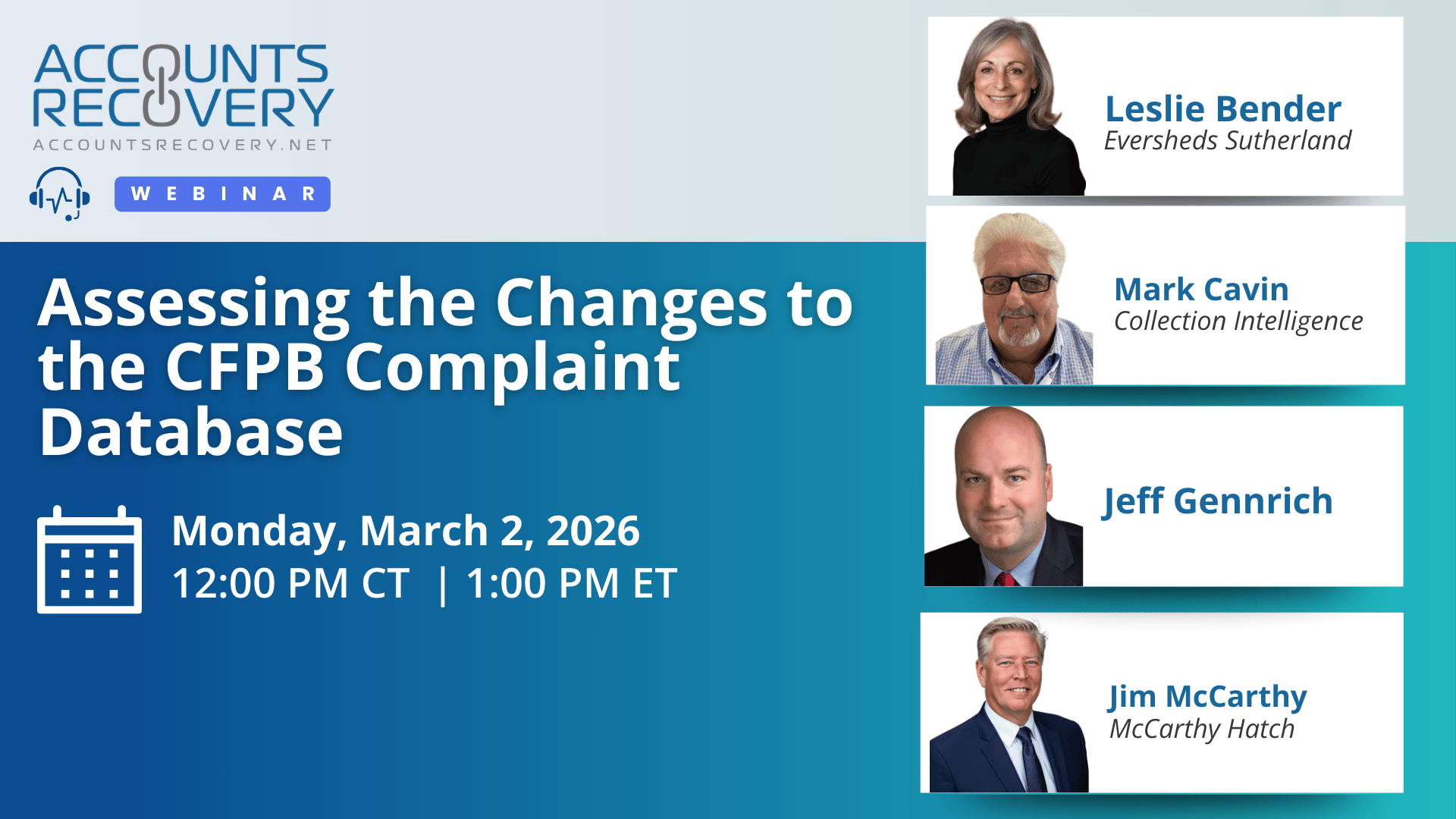
TODAY’S WEBINAR

UPCOMING WEBINARS
 |  |
 |  |
 |
Judge Tosses FDCPA Claim Over Commercial Lease, Allows FCRA Do-Over
A District Court judge in Wisconsin has granted a defendant’s motion to dismiss claims it violated the Fair Credit Reporting Act and the Fair Debt Collection Practices Act by attempting to collect a business debt as a personal debt.
Judge Allows FDCPA Claim to Proceed Over Delayed Tradeline Deletion After Settlement
A District Court judge in Illinois has partially denied a defendant’s motion for summary judgment in a Fair Debt Collection Practices Act case related to a delay in how quickly the defendant deleted a tradeline from the plaintiff’s credit report that resulted from the settlement of an underlying collection lawsuit.
Appeals Court Grapples With Fate of CFPB
Appellate judges in Washington yesterday openly questioned whether the Trump administration can move forward with plans that would effectively hollow out the Consumer Financial Protection Bureau, including laying off up to 90% of its workforce and suspending core functions mandated by Congress. During nearly three hours of oral arguments before the full Court of Appeals for the District of Columbia Circuit, judges pressed government lawyers on whether federal courts have the authority to block mass reductions in force at the CFPB while litigation over the agency’s future plays out. For the credit and collection industry, the case has become a pivotal marker of whether the CFPB will remain a meaningful regulator or be sidelined for years.
40 Companies Seeking Collection Talent
Regardless of whether you are looking to become the new director of operations at a collection operation, or the vendor manager at a fintech, or a human resources generalist at a collector, or the manager of data science at a consumer lending operation, or one of three dozen other jobs listed in this week's job listing summary, there is something for you.
WORTH NOTING: Home prices did not have a good year in 2025 ... Jamie Dimon, the CEO of JPMorgan, has a lot of anxiety about the future ... Nine questions you should never ask Siri or Alexa ... Movie director Steven Soderbergh keeps track of all the media he consumes on a daily basis ... "Snow washing" is the Internet's latest obsession. Does it work? ... Takeaways from last night's State of the Union address ... Consumer confidence in the economy is picking up ... The states where Americans lie, cheat, and scam the most.
Wisdom Wednesday, part I
Wisdom Wednesday, Part II
Webinar Recap: Patient Responsibility and Compassionate Collections: What’s Working in Healthcare Revenue Cycle

The recent webinar, moderated by Dennis Barton and sponsored by CSS Impact, explored how healthcare providers and collection agencies can balance patient empathy with effective revenue recovery. Panelists from Revenue Cycle Associates, Med Cycle Management, Action Collection Association, and Creditors Bureau Associates shared strategies for navigating rising patient responsibility, insurance complexities, and financial stress.
A recurring theme was the importance of education and clarity. As Candice O’Brien noted, “Patients do not like surprises,” emphasizing the need for real-time eligibility checks, accurate estimates, and transparent communication before care. Scott Ingram highlighted that most calls are “basically on education and counseling,” underscoring the role of collectors as financial navigators rather than mere debt pursuers. Mark Craig added that explaining how deductibles and co-insurance drive balances helps position hospitals as advocates, not adversaries.
Panelists also discussed innovative approaches to payment plans. O’Brien introduced the concept of “payment of intent”—even small payments can shift a non-payer into a payer and change collection trajectories. Calder Willingham stressed the use of data enrichment to stratify patients by socioeconomic status, enabling equitable outcomes for both providers and patients.
Insurance denials and billing confusion remain major friction points. Craig criticized insurers’ tactics of deflecting responsibility, while O’Brien emphasized denial management and collaboration with providers to mitigate losses. Panelists agreed that redesigning patient statements with simplified language and clear breakdowns can reduce misunderstandings and improve patient trust.
🧠 Key Takeaways:
Prioritize financial clarity: Use real-time eligibility, accurate estimates, and simplified patient statements to reduce confusion and build trust.
Adopt flexible payment strategies: Incorporate options like payment plans and “payment of intent” to prevent accounts from escalating to bad debt.
Leverage data and collaboration: Use data enrichment to tailor workflows and partner with providers on denial management and charity care.
Webinar Recap: Turning Tax Season into Recovery Season

Tax season represents one of the most critical opportunities for debt recovery, with $91 billion in refunds projected to enter the market and one-third of consumers planning to use those funds to pay down debt. In a recent webinar sponsored by Solutions by Text, industry leaders shared strategies to maximize recovery during this short but impactful window.
Panelists emphasized that timing is everything. Jon Balon, advised agencies to “have your strategy follow the refund calendar,” targeting consumers as direct deposits hit in February through April. Gordon Beck highlighted the importance of standing out amid heavy competition: “When the money hits, this is the easiest account to resolve,” he explained, noting that MMS banners and quick payment links can make resolution feel inevitable. Nick Babinsky stressed personalization, encouraging agencies to offer reminder scheduling and use keywords to capture consumer intent. Shawn Curtis added that planting the seed early—by asking consumers if they’d consider a settlement when refunds arrive—can keep repayment top of mind.
The panel agreed that convenience often outweighs persuasion. Frictionless payment options like Apple Pay, Google Pay, and Venmo are increasingly decisive, with some agencies reporting that mobile wallets accounted for over half of payments within 90 days of adoption. Combatting “shopping cart abandonment” was another focus, with strategies such as automated texts after missed calls or incomplete portal visits to re-engage consumers.
🧠 Key Takeaways:
Align outreach with refund schedules: Target consumers around IRS deposit dates to maximize engagement.
Stand out with MMS and mobile wallets: Use banners, infographics, and logos of trusted payment methods to make repayment easy and memorable.
Personalize and follow up: Offer reminder scheduling, name collectors in messages, and re-engage abandoned interactions to capture intent before it fades.
Did you know you can get full access to all of my past webinars, along with transcripts and summaries of each, for only $29/month? Sign up to be a premium subscriber today!
The Daily Digest is sponsored by TCN