- AccountsRecovery Daily Digest
- Posts
- Daily Digest - December 9, 2025
Daily Digest - December 9, 2025
Brought to you by: TCN | By Mike Gibb

Mike Gibb
December 09, 2025

🎂 Happy birthday to: John Hughes of Williams & Fudge, Kaitlyn Filippi of Arbeit, Jessica Marquis of Crown Asset Management, and Jason Steele of CardCon.
🎉 Congratulations for starting a new position: Justin Layne as Executive Director - Chief of Staff at J.P. Morgan.

New Speakers Being Added Daily
Check out ARMTech.live for the growing list of impressive speakers who are going to be in Dallas. This is going to be the must-attend event of the year!
Plaintiff Claims Improperly Renewed Judgment Cost Her Job
Here it comes, your understatement of the day … Judgments are tricky. Renewing judgments even more so. A collection law firm and two if its employees are being sued for violating the Fair Debt Collection Practices Act and state law in Arizona because the plaintiff was turned down for a job because the prospective employer learned that the plaintiff had a judgment against her, a judgment, the plaintiff claims, was wrongfully renewed after it had expired.
This series is sponsored by WebRecon

A MESSAGE FROM TCN

TODAY‘S WEBINAR

UPCOMING WEBINARS
 |  |
 |
Coerced Debt Bill Sent to N.Y. Governor
The New York legislature has passed a law and sent it to Gov. Kathy Hochul that prohibits creditors from enforcing coerced consumer debts while also creating a private right of action.
Judge Rejects Late Attempt to Add Defendant After FDCPA Deadline Passes
Waiting until the last minute to file a Fair Debt Collection Practices Act before the one-year statute of limitations expires is not always the best idea, a plaintiff has learned. A District Court judge has denied the plaintiff’s motion to file an amended complaint after the plaintiff learned the identity of one of the defendants and sought to include him.
Judge Denies MTD in FCRA Suit Over Reporting of Post-Petition Debts
A District Court judge in Illinois has denied a defendant’s moition to dismiss claims it violated the Fair Credit Reporting Act after noting that a pair of debts were discharged in bankruptcy even though they were incurred after the bankruptcy had been discharged.
Congressional Report Details CFPB Funding Fight
A new Congressional Research Service (CRS) report sheds fresh light on the Consumer Financial Protection Bureau’s increasingly precarious financial situation, outlining years of budget growth, sharp political swings, and a looming operational cliff as the agency’s funding becomes a centerpiece of Washington’s latest regulatory showdown.
WORTH NOTING: never too early to start planning: the best cities for New Year's Eve celebrations ... Tracking consumer lending is getting tougher and tougher, which is making everything riskier and riskier ... In some markets today, fewer than 1 in 50 house listings are affordable to the typical household ... The Department of Education has added a new earnings indicator on its FAFSA form ... Consumers are expecting medical costs to spike big-time next year ... Not very many people felt that 2025 was a "great" year ... The 25 best songs of 2025 ... The cities with the largest turnover rates are in Missouri, Texas, Indiana, and Nevada.
Trailer Tuesday, part I
Trailer Tuesday, Part II
Webinar Recap: Broken Promises Revisited: Why Digital Channels Make PTP Risk Worse (and How to Fix It)
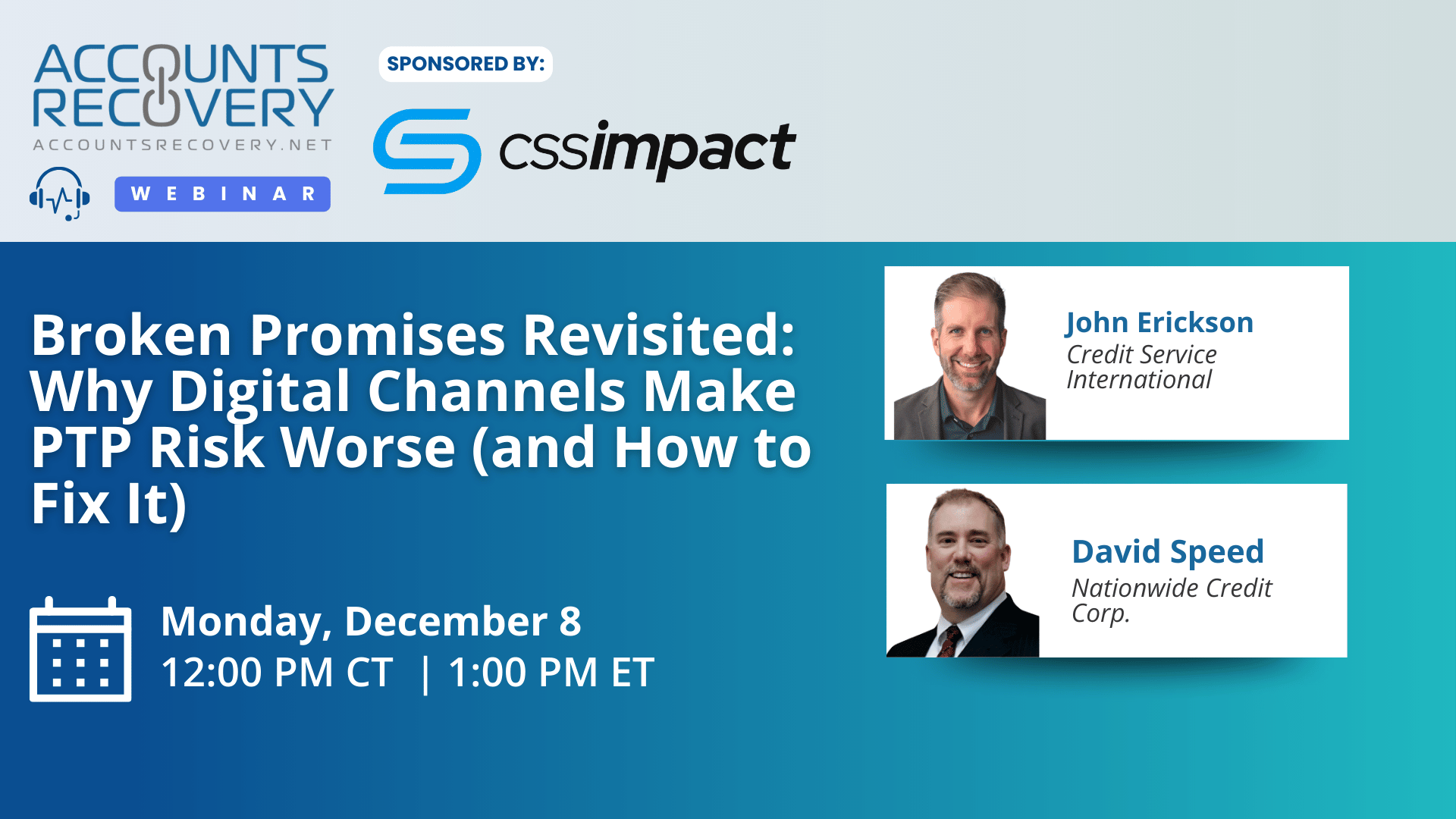
The webinar, "Broken Promises Revisited: Why Digital Channels Make PTP Risk Worse (and How to Fix It)," addressed how the shift to digital communication (text, email, and portals) has changed Promise-to-Pay (PTP) behavior in collections. While digital channels allow collectors to cast a "wider net" and generate more promises due to their low cost and ease, they also quietly increase PTP breakage rates.
Panelists John Erickson, Gary Herman, and Dave Speed agreed that the core collection process remains fundamentally the same, regardless of the channel. The key is translating best practices from live collectors into digital form. They stressed that while PTP is a strong indicator of a consumer's likelihood to pay, digital engagement requires strategic follow-up to ensure success.
To mitigate breakage, collectors must focus on transparency and setting realistic payment expectations. Instead of relying on human agents to follow up on every broken promise—especially low-dollar ones where the operational cost outweighs the potential return—agencies must leverage dynamic, multi-channel messaging and automated reminders. John Erickson highlighted that layering channels (e.g., sending a text followed by a phone call) can drive significantly higher recovery rates.
🧠 Key Takeaways:
Layer Your Communications: Use an omnichannel approach by layering digital and voice channels (text, email, and phone calls) to deliver reminders and follow-up messages. This multi-channel engagement creates urgency and drives higher recovery rates.
Make Plans Realistic: In digital channels, offer multiple payment options—such as using a slider bar—to help consumers set a plan they can actually afford. Ensuring the plan is realistic and easy to adjust or secure is critical to preventing breakage.
Track Digital PTP Data: Establish systems to consistently collect and organize PTP data across all digital channels (portals, text, email). This foundational step is necessary before you can analyze trends or operationalize strategies to prevent broken promises.
Did you know you can get full access to all of my past webinars, along with transcripts and summaries of each, for only $29/month? Sign up to be a premium subscriber today!
The Daily Digest is sponsored by TCN
