- AccountsRecovery Daily Digest
- Posts
- Daily Digest - April 27, 2026
Daily Digest - April 27, 2026
Brought to you by: TCN | By Mike Gibb

Mike Gibb
April 27, 2026

🎂Happy Birthday to: Amrutha Prathipati of JP Morgan Chase, Amanda Loughmiller of Quilling, Selander, Lownds, Winslett & Moser, P.C., Scott Medley of Key2Recovery, Tracey Gibson of Viking Client Services, Michael Myers of Reposession Management Services, Jonathan Ritchie of Spring Labs, and Harvey Goldberg of Park Place Finance. Happy belated Birthday to: Caren Enloe of Smith Debnam (April 26), Nico Diaz of Domu (April 26), Rose Sygit of GE Healthcare (April 25), and David Chadwick of Waterman Receivables Management Pty Ltd (April 25).
🎉Congratulations for starting new positions: Laurie Kimmons-Fortier as Account Resolutions Manager at Carolina's Telco Federal Credit Union, David Braz as VP Asset Strategy at Navigant Credit Union, and Sjorn Lundquist as Head of Revenue at Overtime.
Logo Madness!
It’s time to crown the best logo in the industry. Full bracket available here so you can track the competition. Click on the link underneath the logo to choose your winner. Voting is open for 24 hours.
 |  |
Which logo deserves to advance? |
Does “Reject to Pay” Trigger a Cease? Colorado Judge Says It MightDoes “Reject to Pay” Trigger a Cease? Colorado Judge Says It Might
A Magistrate Court judge in Colorado has denied a debt collector’s motion for summary judgment in an Fair Debt Collection Practices Act case that turns on a deceptively simple question: when a consumer says “I reject to pay,” is that enough to trigger a cease in communications? The judge did not definitively answer that question. Instead, she ruled that a reasonable factfinder could interpret the consumer’s language as a refusal to pay, meaning the case must proceed to trial rather than being dismissed early.

A MESSAGE FROM TCN

TODAY’S WEBINAR

UPCOMING WEBINARS
 |  |
 |
Bankruptcy Filings Continue Climb, Up Nearly 12% Through Q1
Bankruptcy filings continue to trend upward, reinforcing a pattern that credit and collection professionals have been watching closely for more than a year. New data from the Administrative Office of the U.S. Courts shows total filings increased 11.9% in the 12-month period ending March 31, 2026, reaching 591,850 cases.
Judge: Reliance on Furnisher Data Was Reasonable, But Dispute Handling Heads to Jury
A credit reporting agency’s reliance on data from a collection firm, even when that data is later disputed, is not automatically unreasonable under the Fair Credit Reporting Act, a District Court judge in Illinois has ruled, while leaving key questions about dispute handling and reinvestigation procedures for a jury to decide.
Report Flags Risks in Fast-Moving Debt Collection Cases in Small Claims Courts
A new report from Harvard Law School’s Consumer Protection Clinic is examining how high-volume debt collection cases are handled in small claims courts, focusing on the widespread use of “coverage attorneys” and the pace at which cases move through the system, according to a published report.
Compliance Digest – April 27
Insights from 10 different experts -- Lori Quinn, Marissa Coyle, Monica Littman, Roshni Patel, James K. Schultz, Loraine Lyons, Drew Cicero, Laurie Nelson, Akeela White, and Virginia Bell Flynn on important topics ranging from new rules from the FCC, a House hearing on credit reporting reforms, and court rulings on the FDCPA, FCRA, and more.
This series is sponsored by Frost Echols
WORTH NOTING: Experts say artificial intelligence can now read the risk in your voice ... Whether you believe it or not, Shadow AI is inside your operation. Now what? ... An account of someone who used AI to dispute a dental bill ... A look at the best and worst entry-level jobs today ... The emojis you use at work determines how competent your colleagues think you are ... To buy this home in San Francisco, you need to use Anthropic equity ... Science has picked the time when food cravings hit the hardest ... Why your summer BBQ is going to cost more this year.
Music Monday, part I
Music Monday, Part II
Webinar Recap: Building an AI Governance Structure That Can Evolve With the Technology
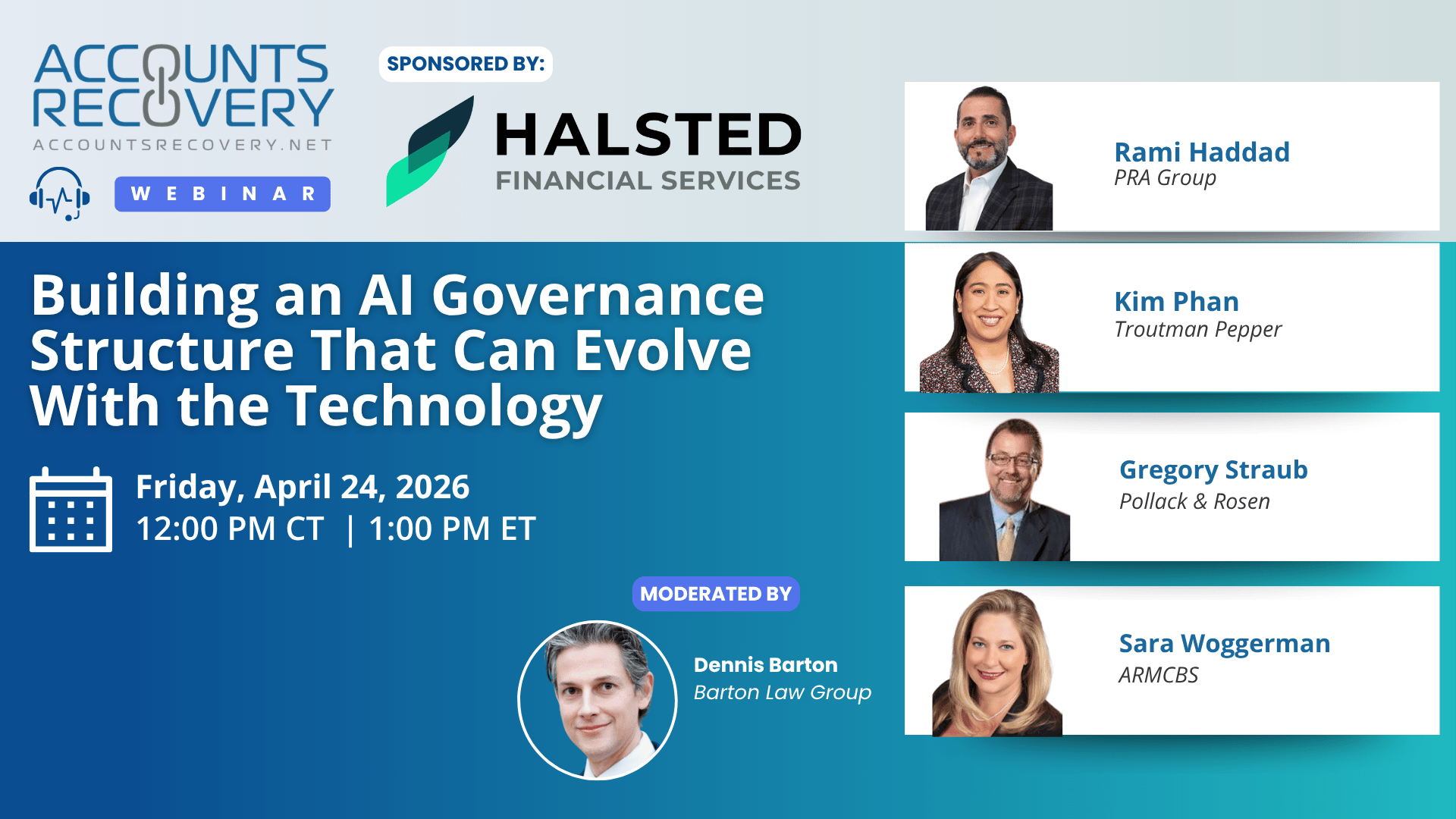
AI is rapidly transforming credit and collections—scoring consumers, automating calls, and predicting payments. But without strong governance, agencies and financial institutions risk compliance failures, bias lawsuits, and stalled rollouts. In this webinar, sponsored by Halsted Financial, industry leaders emphasized that AI governance should be treated as an extension of existing compliance management systems, not a reinvention.
Panelists Kim Phan (Troutman Pepper), Sara Woggerman (ARMCBS), Rami Haddad (PRA Group), and Gregory Straub (Pollack & Rosen) highlighted practical steps for building flexible frameworks that scale with technology. They stressed the importance of defining AI for your organization, creating permissible use policies, and continuously auditing outputs to ensure fairness and compliance.
Key insights included the need to anticipate “shadow AI” use by employees, validate vendor tools beyond initial deployment, and contractually manage third- and fourth-party risks. Publicly available frameworks like NIST’s AI Risk Management Framework and ISO standards were recommended as starting points for organizations unsure where to begin.
🧠 Key Takeaways:
Start with an AI Inventory & Definition
Document where AI is being used, define what counts as AI in your business, and establish clear permissible use policies.Plan for Shadow AI & Human Oversight
Employees may use unauthorized tools—monitor for this risk, and ensure humans remain accountable for AI outputs to avoid automation bias.Strengthen Vendor & Contract Controls
Audit vendors for AI use, include contractual provisions for data privacy and AI governance, and prepare for vendor instability in a fast-changing market.
This session underscored that AI governance is not about slowing innovation—it’s about building resilient systems that evolve with technology while protecting consumers, creditors, and institutions.
Did you know you can get full access to all of my past webinars, along with transcripts and summaries of each, for only $29/month? Sign up to be a premium subscriber today!
The Daily Digest is sponsored by TCN
